Subheader

Adventures in History and Romance

Wednesday, July 27, 2011

What I Did on My Summer Vacation (Part 1)

Summer is only half over, but has already seen two exciting adventures: my trip to the RWA National Conference in New York City, and a trip to the North Carolina Mountains to hike to some magnificent waterfalls.

My time at the RWA conference started with a bang as I won this nifty award for my screenplay "The Last Resort":


Then came the conference itself. I had a blast, learned a lot at the workshops, and had wonderful pitch sessions with agents and editors. I'm excited to see where the many opportunities opened to me will lead.

I was too busy at the conference to take photos, but I did manage a few touristy things with my roommate after the conference and before our mad dash to the airport, such as a brief tour of Central Park:


Coming soon: Summer Vacation Part II, in which my hubby and I get up close and personal with some magnificent waterfalls!

Monday, June 27, 2011

Interviewed by a Charming Rake

I’m participating in a blog chain with my fellow Heart of Carolina Romance Writers this month. This has been my first time doing a blog chain, and it has been loads of fun. At the bottom of this blog entry you’ll find a list of all the participants. I highly recommend reading their posts--you will be delightfully entertained!

The theme of this blog chain is...
Have one of your characters, from one of your stories interview YOU!

Part One: Briefly describe your interviewer.

Part Two: The interview, with — ‘you’ being the subject!

Everybody on board?  Here goes!

The Character...

Mr. James Simpson is a secondary character (but please don’t tell him that--after all, everyone is the hero of their own story, right?) in my yet-to-be-published book The Heiress Returns, set in 1851. James is London’s most amiably scandalous bachelor. He is so much fun to be around that any trouble he gets into never seems to stick. He’s also a master at witty banter. Although his time period is a few decades before Oscar Wilde’s plays, if you’ve ever seen “The Importance of Being Earnest” you’ll know what to expect from James!

The Interview...

I wait for James impatiently, because I’m leaving for New York very early Tuesday morning and I have a ton of things to do before I go. FINALLY James arrives, looking quite dashing in his perfectly tailored suit with yellow cravat and matching waistcoat. He removes his top hat as I let him in. Somehow the hat has not managed to disarrange his wavy brown hair.

His blue eyes twinkle as he gives me a gorgeous smile and kisses my hand. “A pleasure, Mrs. Harrington, as always.”

I try to reprimand him, despite smiling in return. “You are late, James.”

James takes a moment to check his cravat in the hallway mirror and says with a gleam in his eye, “I apologize. I’m afraid a certain young lady kept me out very late...”

“No doubt,” I reply dryly. I lead him to the living room and offer him a chair.

He looks around with amusement. “What a charming little cottage. Where is the main house?”

I try not to sound too taken aback. “Erm, this is it. It’s only a modest ranch, but we like it. Shall we get right to the interview?”

“Yes indeed!” He leans forward in his chair, his hands on his gold-handled cane, looking as though he were in a theater and an exciting play was about to begin. “I have several burning questions to ask you. I confess, I find you extremely fascinating.”

“Me? Fascinating?” I can’t help blushing.

He nods. “You seem to have made some decisions that I consider quite shocking.”

This startles me, as I can’t think of much that would shock James. “I’ve led a fairly tame life, actually. Although I have traveled a lot, and those three years I spent in Montreal and Ottawa, Canada were amazing--”

“No, no, no, I’m not talking about all that,” James breaks in. “What I want to know is, why did you do it?”

“Do what?” I say, not comprehending. “Get married? Move to Raleigh? Decide to become a writer? That last question’s easy. See, my mother was a writer. Margaret Wayt DeBolt -- she wrote a wildly popular book called Savannah Spectres, and also Savannah, A Historical Portrait. She was a journalist, but I’ve decided to go the fiction route...”

I stop myself. James is laughing and shaking his head.

“You’re not taking notes,” I point out.

“Dearest, you’re missing the point,” James replies. “What I want to know is, why, oh why, did you make me the secondary character?”

Oops. Somebody told him. Also, I should have known this interview would be largely about James.

He confirms this as he continues, “It hurts my pride to think I am only in the book for comic relief.”

“That’s not the case at all,” I hasten to assure him. “You play a vital role in the story, after all.”

“I’m aware of that,” he says, somewhat pettishly. “The so-called hero and heroine...”

“Geoffrey and Lizzie.”

“Right. They would never have gotten together in the end if it weren’t for me. So why am I not the hero?”

I try to think of a diplomatic way to explain. “You see, James, in my books the hero and heroine get married in the end. You have stated plenty of times that you are not the marrying kind.”

He looks incredulous. “Have I?”

“Remember that conversation where Lizzie asks Geoffrey, ‘How many men would face any obstacle, and go to the ends of the earth for their love?’ Do you remember the remark you made when you overheard this?”

He looks at me blankly.

I try to imitate his joking tone as I quote: “I certainly have never flung myself off the map for another. It sounds terribly uncomfortable.”

James waves a dismissive hand. “That was all in jest, of course. I was merely trying to lighten a very tense situation. Actually, I am a hopeless romantic. Remember the time I told my aunt that I would never marry simply for money?” He adds as an aside, "Even though God knows I need it..."

I smile. “I remember. You said, ‘I shall wait until perfect love falls upon me. Or knocks me over’.”

“I also said that I have no doubt that I shall succumb in time. In the meantime, I intend to live in the present and make myself merry, rather than worry about whom I shall marry.”  He smirks, looking quite pleased with his little joke.

“James, I will let you in on a little secret,” I say with the air of one imparting an important confidence. “The Heiress Returns is the first in a trilogy. I have big plans for you by book three.”

“Ah, hah!” he says. “I knew you had something up your writer’s sleeve. What is it? You must tell me everything.”

“I’m afraid I can’t do that,” I say with mock seriousness.

His eyes sparkle. “Being coy now, are we?” He considers the information I’ve given him. “Book three. Why not book one?”

“You have to admit, Lizzie and Geoffrey’s story is quite compelling,” I say, in an effort to appease him. “She pretends to be a missing heiress, sort of like the woman in Anastasia. But then she falls in love with Geoffrey, the man who is supposed to be her brother-in-law. And Geoffrey, who is the youngest son of a baron, is dealing with having suddenly been made a baron himself--a position which he did not want and was not trained for. His story reminds me of George VI in The King’s Speech. Except he does not stammer.”

I can see that all of this is not convincing James. So in desperation I add, “You take the lead in a later book because I want to save the best for last, of course!”

“Now you are talking sense!” he proclaims.  “That’s what I love about you--you have an innate sense of timing.”

“Speaking of timing...” I check my watch. “James, we’ll have to cut this short. I’m going to New York tomorrow, and I’ve got to get packed.”

“New York? That backwater? Whatever for?”

“I’m going to the annual conference of the Romance Writers of America. I’m looking for an agent and an editor for the book. I want to get it published, so that many more people can get to know you!”

James rises and reaches for his hat. “Well in that case, what are you waiting for my girl? You must leave right this instant!”
 ________________________

I hope you’ve enjoyed my little chat with James. Please stop by the other participants’ blogs, where you’ll find more great interviews!

6/6: Aimee Laine : http://www.aimeelaine.com/blog
6/8: Lyla Dune : http://lyladune.com/blog.html
6/10: Carol Strickland : http://carolastrickland.blogspot.com/
6/12: Amy Corwin : http://amycorwin.blogspot.com/
6/14: Lilly Gayle : http://www.lillygayleromance.blogspot.com/
6/16: Rebekkah Niles : http://juturnafaerthing.blogspot.com/
6/18: Laura Browning : http://www.laurabrowningbooks.blogspot.com/
6/20: Andris Bear : http://andrisbear.wordpress.com/
6/22: Marcia Colette : http://marciacolette.wordpress.com/
6/24: Nancy Badger : http://www.nancylennea-inlove.blogspot.com
6/26: Sarah Mäkelä : http://blog.sarahmakela.com
6/28: Jennifer Harrington : http://www.romanceadventures.blogspot.com/ (Hi, everyone!)
6/30: Scott Berger : http://romanticadventurestories.wordpress.com/

Friday, June 17, 2011

Mary Stewart and Memory Lane

The recent reissues of Mary Stewart books by Hodder and Stoughton got me thinking again about one of my favorite all-time authors.

I discovered Mary Stewart books in high school and was instantly enthralled, working my way through every one.  They were the perfect blend of adventure and romance.  She was also ahead of her time when she added a paranormal element in Touch Not the Cat.  Years later, as I am now trying my own hand at writing, her books are uppermost in my mind as the standard for quality and style.

Her gorgeous and evocative descriptions of the locations in her books made me want to get to France, Greece, England and Scotland. Still working on that list, but I did get to France in 2007.  While in Provence, I toured the places around Avignon, Nimes, and Marseilles mentioned in Madam, Will You Talk. Although the landscape has changed over the years, it was still so easy to imagine the events of the book. I especially loved the Temple of Diana in Nimes, the spot where the hero and heroine meet. Here is a photo of me and my hubby at that very spot:


Also loved, loved, loved the Pont du Gard:


The ruins of Les Baux, which were wild and lonely at the time Mary Stewart wrote about them, are now a bustling tourist attraction, but they are marvelous nonetheless.


From the vantage point at the top, you can look in one direction and see the wilds that inspired Van Gogh:


On the other side, green and manicured farmland and grapevines, with a hint of the Mediterranean Sea in the distance:


Last fall as I was touring the lush and beautiful countryside in England, I kept remembering the opening line of The Ivy Tree: "I might have been alone on a painted landscape..."

Her books are so lovely and intelligent as well as filled with action and suspense. I hope these reissues will garner a new legion of fans.

PS: Many thanks to Vanessa Kelly, who inspired my trip down memory lane with her own wonderful blog post last week about Mary Stewart!

Monday, May 23, 2011

Romancing the Script Contest Finalist!

So excited to find out that I am a finalist for Scriptscene's Romancing the Script contest!  They even gave me this nifty badge:


My romantic comedy is set at a fictional ski resort in Colorado that combines aspects of my favorite places to ski, and includes a ski patrol heroine and her avalanche search-and-rescue dog. Love! Skiing! Exciting search and rescues! What could be more fun?

The winners will be announced at the end of June.  But really (and I mean this) it's an honor just to be nominated!

More about the contest here: www.scriptscene.org.

Friday, May 20, 2011

What I Love About the Victorian Era

I love the energy and the industry of the Victorians, particularly in the period of 1840-1870, often known as the early to mid-Victorian era, before they settled into the ennui of the end of the decade.  Queen Victoria and Prince Albert were young and vigorous, and producing children at an amazing rate--9 in all! (The popular recent movie The Young Victoria is great for visualizing her as something other than an old woman in widow's clothes.) England was rising to a position of world prominence in trade, manufacturing, and colonization. Their industry and inventiveness was incredible.

People often think of the Victorians as stodgy and repressed. But in the early part of Victoria’s reign, a better description might be energetic, inquiring, and multi-talented. The worlds of science were opening up in ways never before imagined. The future seemed full of enormous promise.

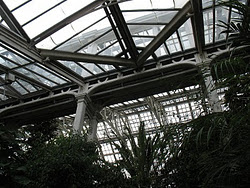
Imagine a giant building made of glass.  It is the length of six football fields. Its roof is three stories high--a portion of it is arched to enclose 90-ft elm trees. When you walk inside, sunlight pours through the glass onto plants, statuary, and colorful banners. The building is filled with exhibitions of engineering marvels of all kinds, not to mention precious gems and other items from around the world. Such a place would be a marvel even today. The building I have just described was built in 1851. It was built in a matter of months with manual labor and real horsepower. The manufacture of plate glass was at that time a new technology. The photo on this blog page of the Glass House at Kew Gardens outside London gives just a tiny taste of what the Crystal Palace must have been like.


This magnificent glass building, which soon become known as the Crystal Palace, was built expressly for The Great Exhibition of the Works of Industry of All Nations, now generally referred to as The Great Exhibition of 1851. Even today the exhibition is considered to be one of the high points for England in the 19th century.  A few weeks ago, Google celebrated the 160th anniversary of the opening of this event with their home page logo (calling it "the first World's Fair"). Prince Albert is often credited with coming up with the idea for this exhibition; this may not be completely true, but he was heavily involved in its planning and promotion and was vital to making it so successful.

It is the background for The Heiress Returns, the first book I have written in a planned trilogy. I have had such a wonderful time researching this era and I hope to bring it vividly to life in my books.

Monday, April 25, 2011

To the Shakespeare Naysayers

I recently saw a trailer for an upcoming movie called "Anonymous". Here is the basic plotline: A political thriller about who actually wrote the plays of William Shakespeare-- Edward De Vere, Earl of Oxford-- set against the backdrop of the succession of Queen Elizabeth I, and the Essex Rebellion against her. It stars Derek Jacobi, who has been on record for a years as believing DeVere wrote Shakespeare's plays.

The movie looks like an exciting conspiracy-theory kind of thriller. But it is, of course, FICTION.

Try watching the 4-part PBS series by Michael Wood called "In Search of Shakespeare" if you are interested in an exciting and thrilling look at his life and work. Far from being dull, this series is electrifying.  Do this BEFORE "Anonymous" comes out this fall. Then see how the two stack up.  My guess is there will be no comparison.

There is far more to Shakespeare’s life to know than had been the accepted line for much of the 19th and 20th centuries. Scholarship of the last 10 years or so has shown just how much we CAN know of the man and his life. Far from being a myth, Shakespeare was the man far more likely to have “written Shakespeare” than any other.  Genius knows no bounds or class. More than education alone (although Shakespeare had a good dose of that), it was a life in the theater, the mind open to all he could see and learn in London, the “forge and working house of thought” as he put it, that helped to shape his plays.

Shakespeare lived in a time of religious and political turmoil. In fact, religion and politics were inseparable. Henry VIII started a tussle for crown and church headship that would continue through his children until Elizabeth firmly established Protestant rule.

Shakespeare’s family was Roman Catholic, the wrong side of the political divide. He would have learned early on to play his cards close to the vest when it came to his personal world views. His own cousin ended up with his head on a pike on London bridge after speaking too publicly about his hatred of the queen and her religious politics.

He was, above all, a poet, and he wanted more than anything else to pursue his art. He had the brilliance to see all points of view, and the wisdom to keep his own beliefs firmly out of sight. This combination enabled him to showcase the multi-variegated sides to every story. He even illustrated with clear brilliance how even every “villain” sees himself as the hero of his own story.  It is why you can read Shakespeare’s works today, 400 years later, and still make a case for any point of view you want.

Also hugely recommended:  Peter Ackroyd's "Shakespeare: The Biography," Stephen Greenblatt's "Will in the World" and James Shapiro's "A Year in the Life of William Shakespeare."  These books plus the PBS series inspired me to write my novella "MUSE OF FIRE."

MUSE OF FIRE reflects this fascinating sense of Will constantly living his life in the balance, on the edge between two warring factions. It contains references to Sonnet 145, which many scholars believe was written by a very young Will Shakespeare to his new wife, Anne Hathaway. There are two puns on her name embedded in the lines, including “Anne saved my life…” Might this literally have happened?  If so, did that event first spark the passion, and later the assiduous care of his family that persisted even after the flame seemed to have died out? MUSE OF FIRE is one guess at what might have happened.

Wednesday, December 8, 2010

Fool for Love

"If thou rememberest not the slightest folly that ever love did make thee run to,
Thou hast not loved."

The quote above is one of my favorites from Shakespeare. Love can make us do amazing things at times. Sometimes it leads us right down that road to "folly."  But it's a journey that we wouldn't give up for all the world. We optimistically expect the joys to outweigh any bruises obtained in the adventure!

I write romances that incorporate lots of adventure.  Some are set in contemporary settings. Some are historical. My most recent is set in 1850's England--a really interesting time, which I plan to write more about in another blog.